Math talks
Communicating mathematics is an important part of one’s job as a mathematician. When I started my mathematical career, I needed to devote a substantial amount of time and effort to improve at this skill, and this improvement was greatly facilitated by feedback from my peers and mentors.
I am continually trying to improve, so if you have any feedback for me about parts of my papers or talks you did not understand as well as you would have liked, I would love to hear it!
Communicating mathematics effectively
In 2018, I co-organized (with John Voight) a week-long workshop titled Communicating mathematics effectively, for late-stage graduate students and early-stage postdocs in number theory to learn and develop strategies for giving clear, motivated, and informative talks; this workshop was funded by my CAREER grant. 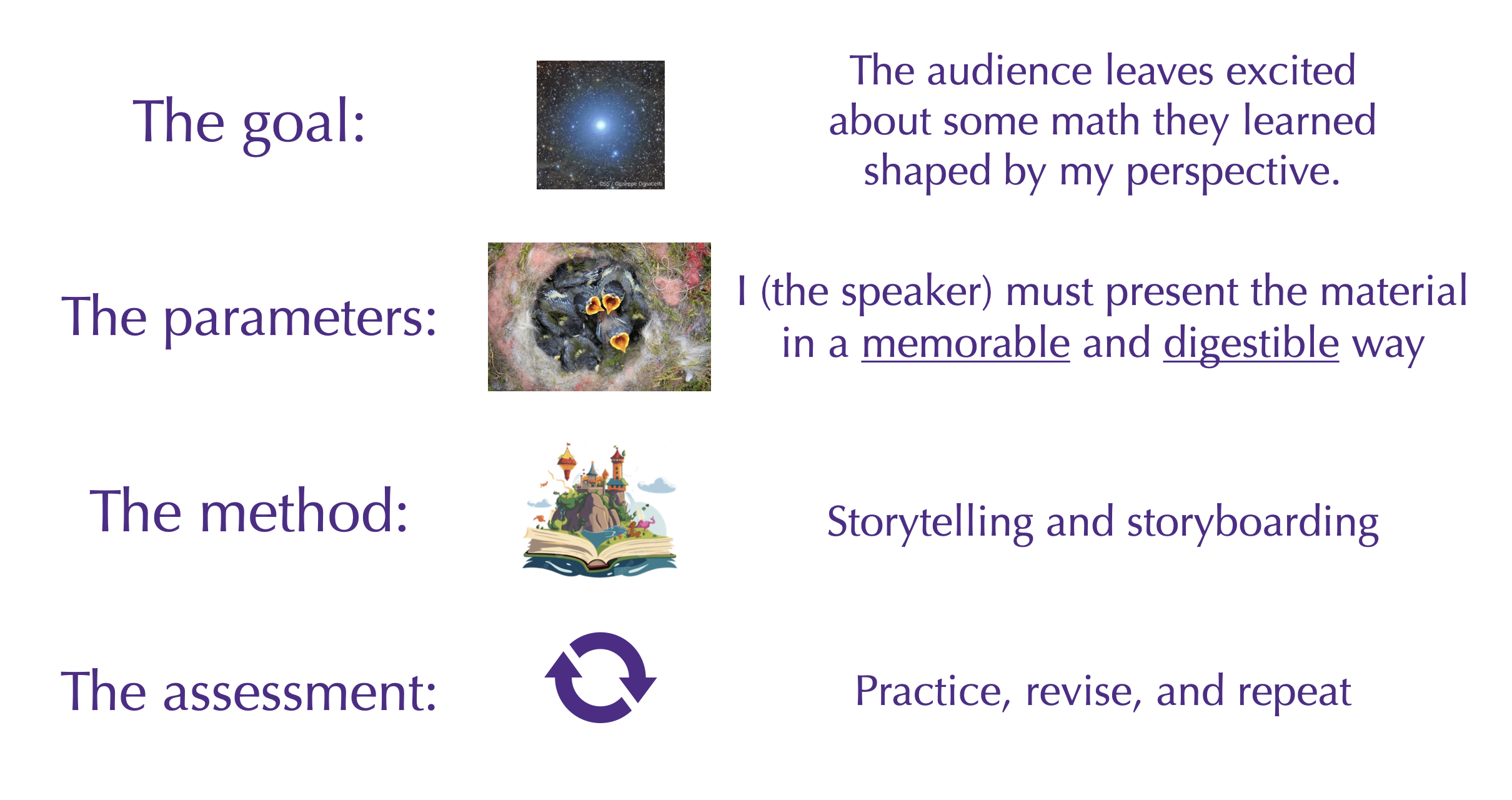
In the years since, I have refined many of the workshop materials to work as stand-alone modules, which I have incorporated into graduate topics courses (one co-taught with Chris Hoffman).
The Value of Mathematical Storytelling (joint with John Voight)
A Notices article laying out the philosophy of mathematical storytelling and how to carry it out in practice.
Worksheets for gaining practice using mathematical storytelling:
- 7 elements of storytelling A worksheet working through translating the elements of storytelling to a mathematical perspective.
- Storyboarding A worksheet with a step-by-step method to develop a storyboard. (See also slides with some examples)
- Talk plan self-assessment A checklist self-assessment to see if your talk is hitting the key narrative elements.
- Peer feedback form A worksheet giving structure for feedback from a practice talk.
Practical tips for giving and preparing a talk (This should be looked at after you have developed a compelling storyboard.)