Research
Recent preprints (updated automatically)
Conic bundle threefolds differing by a constant Brauer class and connections to rationality
A double cover \(Y\) of \(\mathbb{P}^1 \times \mathbb{P}^2\) ramified over a general \((2,2)\)-divisor will have the structure of a geometrically standard conic bundle ramified over a smooth plane quartic \(\Delta \subset \mathbb{P}^2\) via the second projection. These threefolds are rational over algebraically closed fields; however, over nonclosed fields, including \(\mathbb{R}\), their rationality is an open problem. In this paper, we characterize rationality over \(\mathbb{R}\) when \(\Delta(\mathbb{R})\) has at least two connected components (extending work of M. Ji and the second author) and over local fields when all odd degree fibers of the first projection have nonsquare discriminant. We obtain these applications by proving general results comparing the conic bundle structure on \(Y\) with the conic bundle structure on a well-chosen intersection of two quadrics. The difference between these two conic bundles is encoded by a constant Brauer class, and we prove that this class encodes the obstruction to the existence of a section of the first projection \(Y\to\mathbb{P}^1\).
Isolated and parameterized points on curves
We give a self-contained introduction to isolated points on curves and their counterpoint, parameterized points, that situates these concepts within the study of the arithmetic of curves. In particular, we show how natural geometric constructions of infinitely many degree d points on curves motivate the definitions of \(\mathbb{P}^1\)- and AV-parameterized points and explain how a result of Faltings implies that there are only finitely many isolated points on any curve. We use parameterized points to deduce properties of the density degree set and show that parameterized points of very low degree arise for a unique geometric reason. The paper includes several examples that illustrate the possible behaviors of degree d points.
Number fields generated by points in linear systems on curves
We develop techniques for determining the fibers of a morphism of curves \(\phi: C \to D\) over a nonarchimedean local field \(K\). These results have applications to studying closed point on curves over global fields since closed points on \(C\) of large degree or of very small degree are known to all arise as fibers of morphisms.
Quartic del Pezzo surfaces without quadratic points
Previous work of the authors showed that every quartic del Pezzo surface over a number field has index dividing \(2\) (i.e., has a closed point of degree \(2\) modulo \(4\)),, and asked whether such surfaces always have a closed point of degree \(2\). We resolve this by constructing infinitely many quartic del Pezzo surfaces over \(\mathbb{Q}\) without degree \(2\) points. These are the first examples of smooth intersections of two quadrics with index strictly less than the minimal degree of a closed point.
Brauer-Manin obstructions requiring arbitrarily many Brauer classes
On a projective variety defined over a global field, any Brauer–Manin obstruction to the existence of rational points is captured by a finite subgroup of the Brauer group. We show that this subgroup can require arbitrarily many generators.
Complete lists of my preprints and publications can be found on my arXiv page and on my MathSciNet author page (subscription required).
Research areas
Under construction: research descriptions in progress
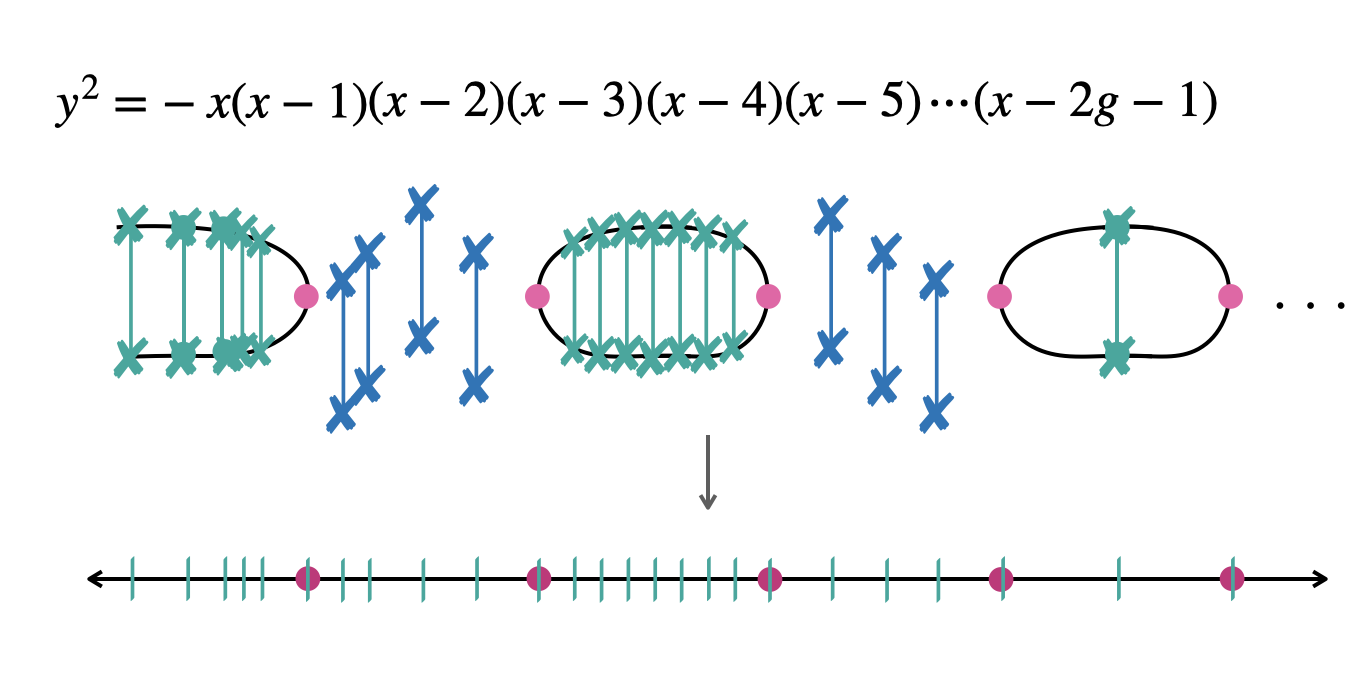
Algebraic points on curves
Leveraging geometric tools to organize \(\overline{k}\) points on a curve over a number field.
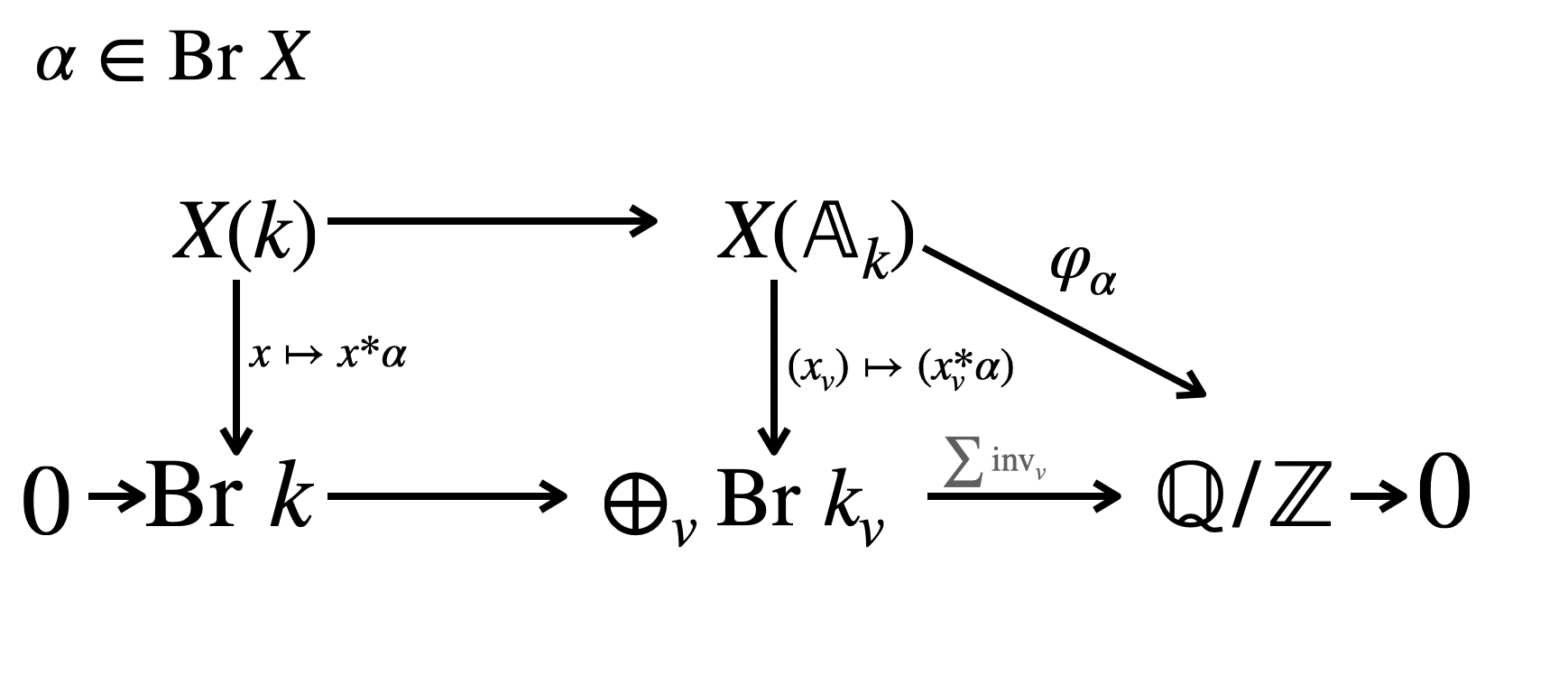
The Brauer–Manin obstruction
Capturing subgroups and studying behavior under field extensions.
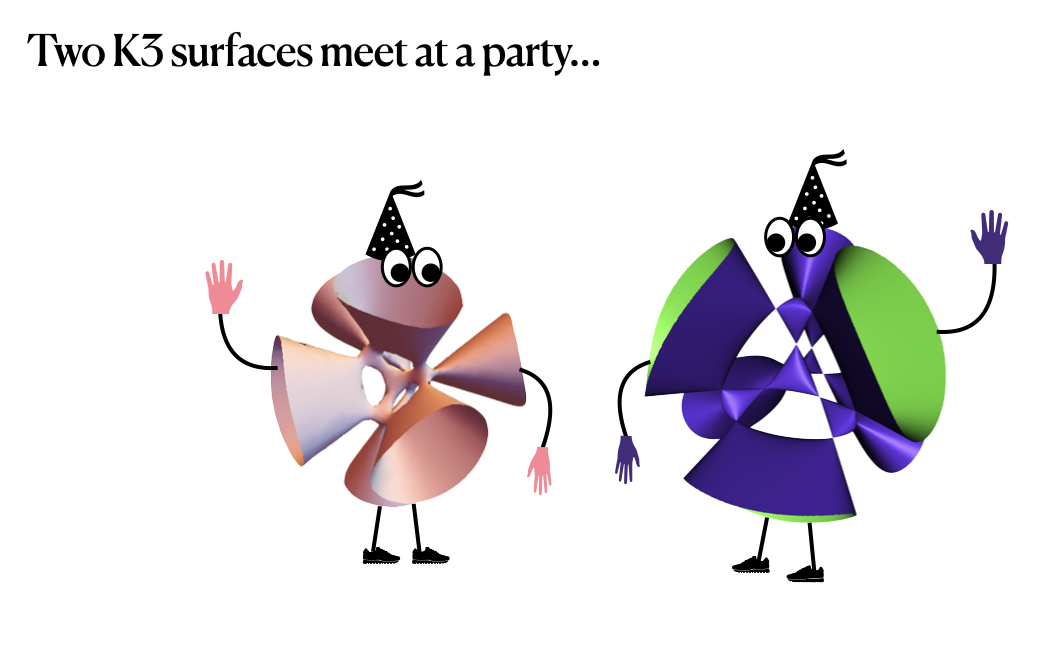
Rational points on surfaces
Explicit computation of the Brauer group and Brauer–Manin obstruction on surfaces.
The arithmetic of a curve over a number field \(k\) encapsulates all of its \(\overline{k}\) points together with the action of the absolute Galois group. Points on curves can also be viewed as divisors, and this dual identity gives powerful geometric tools to approach the problem. My research in this direction aims to leverage these geometric tools to organize and perhaps even understand \(\overline{k}\) points on a curve.
The article Isolated and parameterized points on curves, written jointly with Isabel Vogt, gives an introduction to these ideas with several examples.
Talks
Number Theory Web seminar, May 2026:
Colloquium at CRM, April 2024:
Workshop at ICERM, June 2025: video
Papers
- Number fields generated by points in linear systems on curves, joint with Irmak Balçik, Stephanie Chan, and Yuan Liu — arXiv
- Superelliptic degree sets over Henselian fields, by Alex Galarraga and Alex Wang — arXiv
- Degrees of points on varieties over Henselian fields, joint with Brendan Creutz — arXiv
- On the level of modular curves that give rise to isolated j-invariants, joint with Abbey Bourdon, Ozlem Ejder, Yuan Liu and Frances Odumodu — arXiv
In 2022, I gave a lecture series at the Park City Mathematics Institute (PCMI) Graduate Summer School: Rational points on varieties and the Brauer-Manin obstruction. My lecture notes give an introduction to the Brauer-Manin obstruction, so-called “capturing” subgroups, and questions concerning the Brauer-Manin obstruction over extensions.
Talks (PCMI 2022)
Capturing subgroups
- Brauer-Manin obstructions requiring arbitrarily many Brauer classes, joint with Jennifer Berg, Carlo Pagano, Bjorn Poonen, Michael Stoll, Nicholas Triantafillou, and Isabel Vogt — arXiv
- The \(d\)-primary Brauer-Manin obstruction for curves, joint with Brendan Creutz and Felipe Voloch — arXiv
- Degree and the Brauer-Manin obstruction, joint with Brendan Creutz, with an appendix by Alexei Skorobogatov — arXiv
Obstruction under extensions
- On the Hasse principle for conic bundles over even extensions, by Sam Roven and Alex Wang — arXiv
- Quartic del Pezzo surfaces without quadratic points, joint with Brendan Creutz — arXiv
- Quadratic points on intersections of two quadrics, joint with Brendan Creutz — arXiv
- Persistence of the Brauer-Manin obstruction on cubic surfaces, joint with Carlos Rivera — arXiv
In 2015, I gave a lecture series at the Arizona Winter School about explicit computation of the Brauer group and the Brauer-Manin obstruction on surfaces. Lecture notes are available on the Arizona Winter School website.
Talks (Arizona Winter School 2015)
Papers
- Insufficiency of the Brauer-Manin obstruction for Enriques surfaces, joint with Francesca Balestrieri, Jennifer Berg, Michelle Manes, and Jennifer Park — arXiv
- Unramified Brauer classes on cyclic covers of the projective plane, joint with Colin Ingalls, Andrew Obus, and Ekin Ozman — arXiv
- On Brauer groups of double covers of ruled surfaces, joint with Brendan Creutz — arXiv
- Two torsion in the Brauer group of a hyperelliptic curve, joint with Brendan Creutz — arXiv
- Vertical Brauer groups and del Pezzo surfaces of degree 4, joint with Anthony Várilly-Alvarado — arXiv
- Higher dimensional analogs of Châtelet surfaces, joint with Anthony Várilly-Alvarado — arXiv
- Failure of the Hasse principle for Enriques surfaces, joint with Anthony Várilly-Alvarado — arXiv
- Failure of the Hasse principle for Châtelet surfaces in characteristic \(2\) — arXiv